In 1970, economist George Akerlof published a paper about used cars that would go on to win him a Nobel Prize
Akerlof’s setup was simple. In a used car market, sellers know whether their car is a reliable or a defective.
Buyers can’t tell just by looking or taking a test drive around the block. Because buyers can’t distinguish quality, they’re only willing to pay a price that reflects the average quality of cars on the lot.
Owners of genuinely good cars know their car is worth more than that average price. So they hold back, or leave the market entirely.
What’s left for sale skews toward defective. Buyers, sensing this, lower their price expectations further. Repeat this a few times, and you get a spiral: the good cars disappear, and the market fills with junk.
When quality can’t be verified before purchase, bad quality doesn’t just coexist with good quality — bad quality actively drives out good quality.
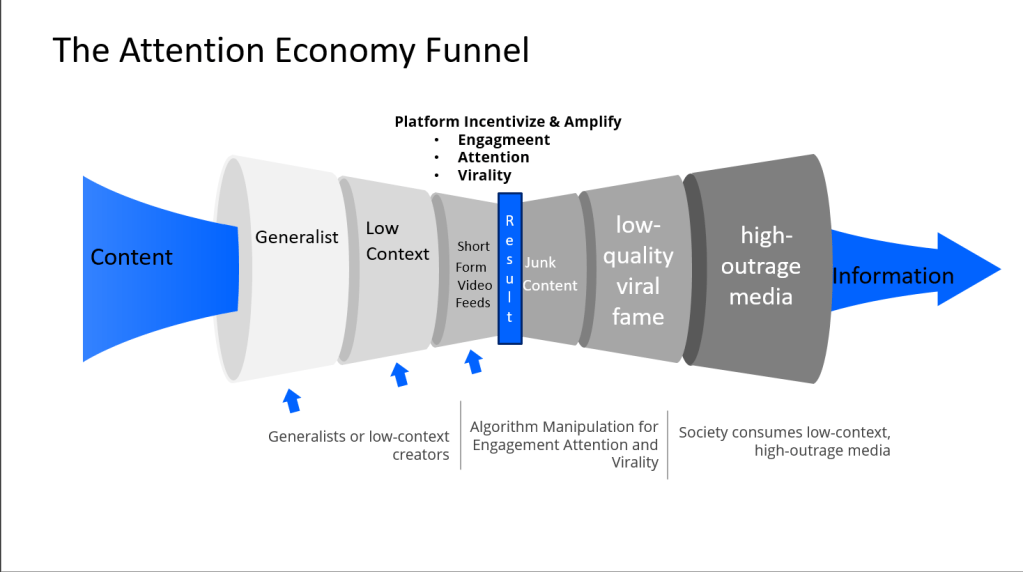
Swap “cars” for “content” and the model holds almost perfectly.
The Engagement Economics
The seller is anyone posting information — a genuine subject-matter expert or a confident amateur or a low context creator
The buyer is we, spending not money but attention and trust.
The asymmetry is that we usually can’t tell, at the moment of consumption, whether a claim is well-founded (Reliable) or just well-delivered (Junk).
Expert often can’t compete. Not because their information is worse, but because the market has no reliable way to price what they’re actually offering.
The Guardrails – Lever’s you actually control
There’s no clean fix on the near horizon. But there are real levers, at two different levels.
At the systemic level:
- Ranking algorithms could weight track record and eventual accuracy alongside engagement
At the individual level
- Treat confidence as a flag to verify, not a reason to trust.
- Follow specific people and publications rather than letting a recommendation feed choose for you.
- Favor formats with more built-in friction — long-form writing, primary sources — over the shortest, most shareable version of a claim.
- Put your attention and money behind trust-based models, not ones optimized for your next 30 seconds of scroll time
- Spot emotional language in your feed : Objective writing uses neutral terms. If an article uses loaded words like “destroy,” “crisis,” “scheme,” or “laughable,” it is trying to manipulate you.
The Honest Bottom Line
Personal guardrails are what you can act on immediately and reliably
Supporting subscription based information models, valuing track records, and rewarding Subject Matter Expert creators with your own attention and money is itself a small contribution to shifting the incentive structure
So the practical stance isn’t “guardrails instead of systemic change” — it’s guardrails now, because they’re the only lever you fully control, while treating your consumption choices as one of the few individual inputs that, in aggregate, can nudge the systemic incentives over time.”
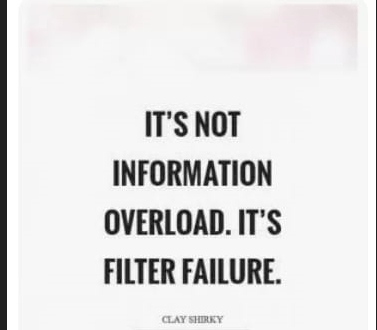
The best filter has always been human. Using it is our choice.”
 accidentalprojectmanager.blog
Leave a comment