
In the early 1980s, the American automotive industry faced intense competition from Japanese manufacturers.
Toyota’s success attracted attention not merely because of its manufacturing efficiency, but because of its approach to continuous improvement, commonly known as Kaizen.
One important principle of the Toyota Production System was respect for people, including the willingness to listen to Team members closest to the actual work.
In many traditional manufacturing environments, decisions flowed from management to the shop floor. Workers were expected to execute instructions.
Toyota emphasized something different.
Team members were encouraged to identify problems, raise concerns, and suggest improvements. Through practices such as stopping production when abnormalities occurred, problems could become opportunities for learning rather than simply reasons for blame.
The underlying philosophy was powerful:
The person closest to the problem may have a perspective that someone higher in the hierarchy cannot see.
Listening to a shop-floor employee did not diminish the authority of a manager.It could make the manager’s decisions better.
Recognizing another person’s knowledge did not make leadership weaker. It made the organization stronger.
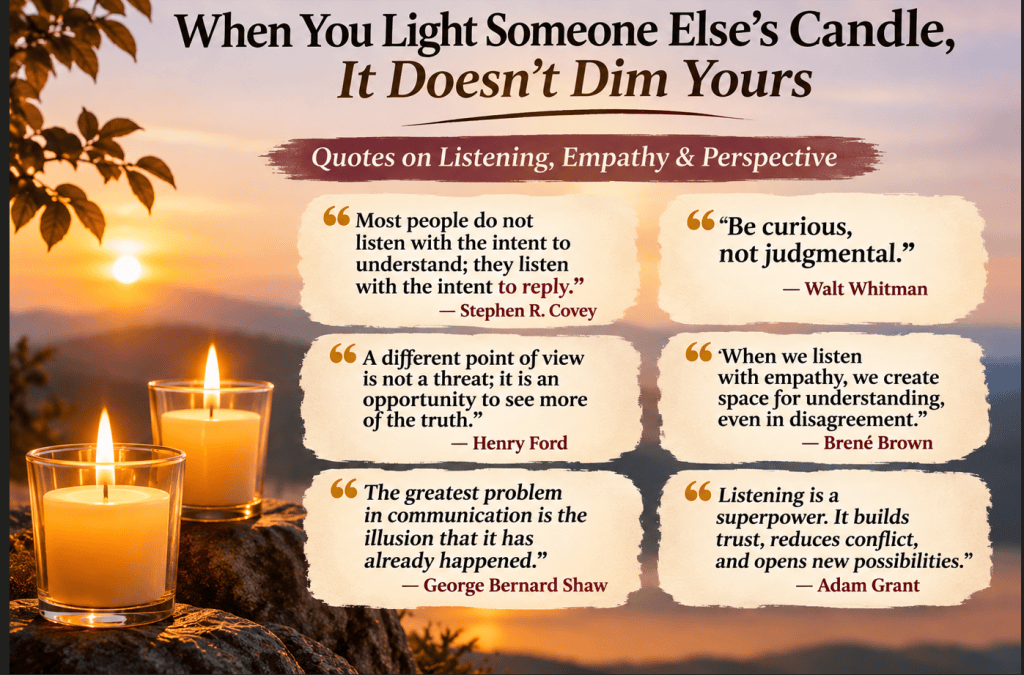
And that is precisely what lighting another person’s candle represents.
It is not about surrendering your own light. It is about creating more light for everyone.
A Simple Call to Action: Light One Candle Today

Perhaps the true measure of communication is not how convincingly we express our thoughts, but how willing we are to understand thoughts different from our own.
Because the purpose of every meaningful conversation should not always be to prove who is right. Sometimes, it should be to discover what we might be missing.
So, the next time someone challenges your perspective, ask yourself:
Am I protecting my own candle from someone else’s light, or am I willing to make the room a little brighter?


Leave a Reply